

On 28 October 2026 the UK’s new Chancellor of the Exchequer John Healy delivered the first Budget of the Andy Burnham government. The speech had promised ‘Breathing Space Now, Hope for the Future’, however the end result was a disappointing non-event, particularly for the asset management industry. The country was perhaps hoping the new leadership would provide something bold, something to inspire, but the reality was fairly muted.
Unlike recent years, very little was leaked in advance, leading to fears that taxpayers should brace for difficult news. There were early suggestions that capital gains tax could be aligned with Income Tax rates, but this rumour was quashed quickly. The headline announcements were that banks will be hit with a higher surcharge, individuals with interest and property income will pay 4% more, double the 2% differential planned, some sleight of hand with writing down allowances will weaken British industry further and entrepreneurs will be taxed more if they do succeed.
For the asset management industry, it was a budget of missed opportunities. Nothing to support UK competitiveness at a time major players in the industry are moving outside the UK and competing financial centres around the world are enticing managers with tailor-made packages. There was no further clarity on the salaried member rules, despite the conclusion of the BlueCrest case in the summer continuing material uncertainty as to how HMRC has approached the legislation for the last 10 years. Nothing to attract top talent or investors to the UK, nor anything to support universities that feed the next generation of talent. Nothing that signals to asset management that the UK is the place to do business.
Given that up to half of the revenue that a typical asset manager generates in the UK will go directly to HMRC, the lack of support feels disappointing. However, with only a few months to prepare, the new leadership team can perhaps be forgiven having been dealt a difficult hand to play. Understanding what the industry adds to the UK and why UK competitiveness on the global stage is critical should be their top priority for 2027.
LLP vs Ltd
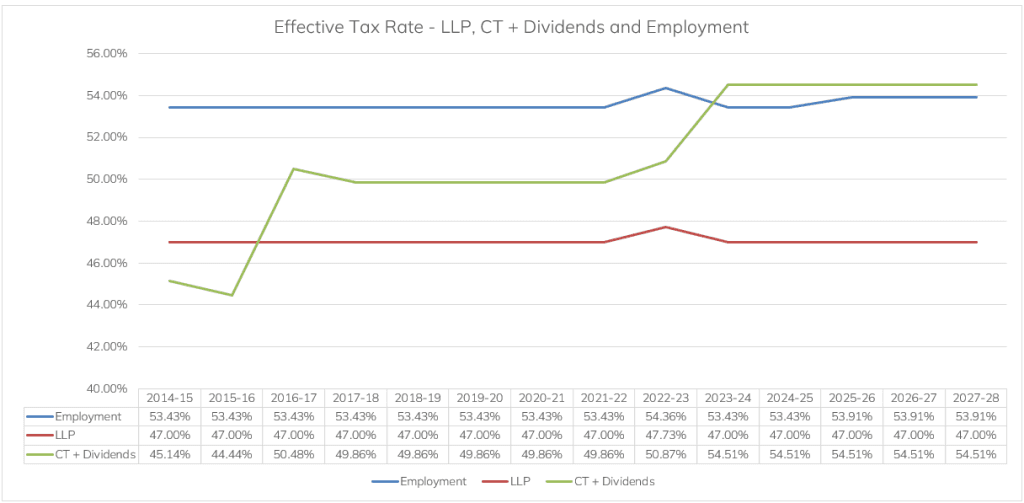
UK asset managers should continue to compare LLP and company structures using the applicable tax rates, the amount of profit retained and the method of extraction. Nothing has changed for 2027/28. Pros and cons remain for both structures, and the best structure for a manager will be a combination of their view on profit extraction, co-investment, talent acquisition, succession planning and certainty – all of which can evolve over the life cycle of a business. LLPs can remain attractive for owner-managed asset managers distributing most annual profits, whereas companies may better support retained earnings, external investment and share-based succession. It is important to assess the whole-life tax and commercial outcome, including co-investment funding, regulatory capital, remuneration and eventual exit, rather than recommend a structure solely by reference to headline tax rates.
Transfer Pricing / Permanent Establishment (PE)
There were no specific changes to UK transfer pricing legislation, but Finance Act 2026 introduced reforms which generally apply for chargeable periods beginning on or after 1 January 2026. These cover the participation condition, intangibles, Commissioners’ sanctions, financial transactions and interpretation in accordance with Organisation for Economic Co-operation and Development (OECD) principles. A conditional exemption also removes the requirement to apply transfer pricing to qualifying UK-to-UK transactions between companies. This is not a blanket exemption for domestic arrangements: the residence, Corporation Tax rate and other statutory conditions must be met. Asset managers should review their intercompany arrangements against the revised rules, rather than assume that all domestic transactions fall outside scope.
Separately, Finance Act 2026 gave HMRC the power to introduce an International Controlled Transactions Schedule (ICTS). The proposed annual filing will capture standardised information on cross-border related party transactions, supporting automated risk profiling and more targeted transfer pricing enquiries. HMRC’s technical consultation on the draft regulations, notice and reporting template ran from 16 June to 31 July 2026.
The intended commencement remains accounting periods beginning on or after 1 January 2027. Asset managers with overseas group entities should assess their potential reporting exposure, the availability of transaction-level data and the consistency of that data with their transfer pricing policies and tax returns. The final scope, exemptions, thresholds and filing requirements should be checked against the regulations and HMRC notice when finalised. In the meantime, managers should review the support for their cross-border pricing, particularly where management, advisory and other service fees are allocated between jurisdictions.
The government has confirmed that the existing small and medium-sized enterprise (SME) exemption from transfer pricing will be retained. This is welcome for qualifying asset managers, although eligibility and the existing exceptions still need to be considered. The substantive transfer pricing exemption and the proposed ICTS reporting requirement are separate questions: managers should establish their position under each rather than assume that SME status alone resolves all cross-border tax and reporting obligations.
A separate reform makes the exemption for foreign PE profits and losses of UK-resident companies mandatory, generally for accounting periods beginning on or after 1 January 2027. This was announced before today’s Budget and should not be confused with the changes to the definition of a UK permanent establishment. The July policy paper provides for restrictions on foreign branch losses and transitional amounts, together with targeted anti-avoidance rules. UK asset management companies operating through overseas branches should assess the effect on loss relief and their UK tax computations.
Investment Manager Exemption (IME)
There were no further amendments to the IME legislation. Earlier in the year there was a move to simplify and clarify the legislation, with the following changes to the IME provisions for accounting periods beginning on or after 1 January 2026:
- the removal of the ‘if, and only if’ construction of the IME to ensure that it acts as a safe harbour and not as a mandatory alternative to the general agent exemption;
- the revision of the scope of the IME to cover a wider range of transactions conducted within a fund;
- the inclusion of ‘investment advisors’ such that the rules equally apply to advisors and managers; and
- the highly anticipated removal of Condition D, ‘the 20% rule’, which has caused practical difficulties for asset managers, and which does not serve a clear purpose as an indicator of independence.
UK asset managers should review their IME risk assessment in line with these changes.
HMRC Compliance for Wealthy Individuals
The Budget announced that the government is modernising its approach to wealthy taxpayers, defined as those with income above £200,000 or assets exceeding £2 million in any of the previous three years. Its plan combines better taxpayer segmentation, connected data, digital services and specialist expertise to identify risks earlier, while reducing unnecessary contact for lower-risk taxpayers. Complex arrangements alone will not be treated as evidence of non-compliance.
The wealthy-compliance programme includes dedicated Customer Compliance Managers for identified billionaires, additional offshore specialists and stronger action against serious non-compliance. Expanded international and crypto asset reporting will improve visibility of overseas holdings, with staff retaining responsibility for AI-assisted compliance decisions. HMRC also plans to improve tax-gap measurement and publish a standalone offshore estimate in 2027.
Additionally, for UK-resident investors in US LLCs and reverse hybrids, the government intends to introduce an elective foreign tax credit mechanism rather than transparent tax treatment. Eligible distributions would be taxed at dividend Income Tax rates, with credit for qualifying foreign taxes paid personally, including federal, state and local taxes. Further technical consultation will precede legislation, with claims intended from early 2028; no specific retrospective solution has been announced.
Income Tax
The Income Tax Personal Allowance is fixed at the current level of £12,570 and will remain frozen until 5 April 2031.
There is a reduction in the Personal Allowance for those with ‘adjusted net income’ over £100,000. The reduction is £1 for every £2 of income above £100,000. This means that there is no Personal Allowance where adjusted net income exceeds £125,140.
The basic rate band remains at £37,700, with the higher rate threshold remaining at £50,270. The additional rate threshold remains at £125,140. The freeze of these thresholds will continue until 5 April 2031. The NIC Primary Threshold and Lower Profits Limit remain at £12,570. The NIC Upper Earnings Limit and Upper Profits Limit will remain aligned to the higher rate threshold at £50,270 up to 5 April 2031 as well. Other employer NIC relief thresholds aligned to the Upper Earnings Limit will also be maintained at this level.
The additional rate for non-savings and non-dividend income will apply to taxpayers in England, Wales and Northern Ireland. The additional rate for savings and dividend income will apply to the whole of the UK.
HMRC plans to recover established lower-value tax debts through regular bank-account deductions where taxpayers repeatedly fail to engage and standard collection action has been exhausted. The original consultation envisaged debts generally not exceeding £10,000, though the final limit remains undecided.
Following consultation, safeguards were strengthened: a minimum 28-day warning period, tailored affordability checks, enhanced joint-account protections and a “Refund first” process for disputed deductions. Tax Credits debts and individuals’ authorised overdrafts will be excluded, vulnerable customers and those who engage with HMRC will leave the automated process, and the scheme will initially cover current accounts only. Draft legislation is expected in summer 2027.
The Budget also announced that the government wants Self-Assessment taxpayers to make smaller payments closer to when income is earned, rather than face a large later bill. Its original proposal would have required taxpayers with sufficient PAYE income, estimated at around 2.1 million people, to make in-year payments through PAYE from April 2029.
After respondents raised concerns about cash flow, forecasting, complexity, confidentiality and reduced taxpayer control, the government changed course. Automated in-year payments, such as Direct Debit, will instead become the default, while eligible taxpayers may opt into PAYE collection. This will also extend to the wider population making Payments on Account, supported by new HMRC digital tools from 2028 for estimating liabilities, tracking balances and making voluntary prepayments.
Despite denying that this was the true purpose behind the Making Tax Digital (MTD) reforms these proposals come less than a year after some self-assessment taxpayers started reporting on a quarterly basis under MTD. Like many tax reforms in recent years improving cashflow for the government is being prioritised over the working capital needs of businesses – swapping the government’s debt issues onto the economy.
Capital Gains Tax
Despite concerns that the Capital Gains Tax (CGT) rates would be aligned with Income Tax rates they remain unchanged for 2027/28. Basic rate taxpayers are charged at 18%, with gains above that band charged at 24%. The annual exempt amount for individuals will remain at £3,000 for 2027/28. Investors in offshore funds with reporting fund status will welcome this stability.
The rate applying for individuals claiming Business Asset Disposal Relief (BADR) and Investors’ Relief will remain at 18% for disposals made in 2027/28. However, for qualifying disposals made on or after 6 April 2027, the lifetime limit will be reduced from £1 million to £500,000. Despite the calls to encourage growth this is yet another attack on entrepreneurs, reducing the incentive to start a business in the UK. The lifetime limit was steadily increased between 2008 to 2011 to £10 million where it remained for 9 years, before steadily being eroded over the past 5 years.
Separately, the government is launching a consultation for a new CGT relief for founders of and significant early investors in high-growth, innovative UK companies. It is proposed that Founders’ Relief will take effect for qualifying disposals made on or after 6 April 2027. The relief will apply a 10% CGT rate to qualifying disposals of shares. There will be a lifetime limit of £10 million of gains per individual. Whilst initially interesting, the stringent conditions mean that this will not be available for the vast majority of entrepreneurs. The value of businesses that meet the conditions is likely to be in excess of £100 million, meaning in practice the relief will only be available for individuals making in excess of £25 million. The proposed relief will only cover a fraction of the gain. Stripping relief away from small family-owned businesses and handing it to multi-millionaire tech bros looks like a departure from Labour’s traditional values.
Carried Interest
There were no further announcements relating to carried interest, despite competing jurisdictions taking action to materially reduce rates to attract asset managers. Carried interest moved into the income tax framework from April 2026, with a 72.5% multiplier for qualifying carried interest. This provides a rate of 34.1% for fully qualifying carried interest (i.e. 10% higher than standard CGT rates), assuming an additional-rate taxpayer in England, Wales or Northern Ireland whose profits are already above the Class 4 NIC upper profits limit. Scottish income tax rates can produce a different result.
The 72.5% multiplier applies only to qualifying carried interest, determined under the fund’s average holding-period rules. Non-qualifying carried interest is generally subject to the full 47% marginal rate (Income Tax at 45% and NIC of 2%) on the same assumptions.
Dividends
Currently, the first £500 of dividends is chargeable to tax at 0% (the Dividend Allowance). This £500 Dividend Allowance is retained for 2027/28.
Dividends received above the Dividend Allowance will be taxed at the following rates for 2027/28:
- 75% for basic rate taxpayers
- 75% for higher rate taxpayers
- 35% for additional rate taxpayers.
Dividends within the allowance still count towards an individual’s basic or higher rate band and so may affect the rate of tax paid on dividends above the Dividend Allowance.
To determine which tax band dividends fall into, they are treated as the last type of income to be taxed.
Savings Income
From 6 April 2027, the tax rates on savings income will be 24%, 44% and 49% for basic, higher and additional rate taxpayers respectively. These are two percentage points above the previously announced rates and four percentage points above the existing rates..
Individual Savings Accounts
The current annual subscription limits are set out below, together with the Budget announcement affecting cash ISAs from 6 April 2027:
- Individual Savings Accounts (ISAs) £20,000. Budget 2026 maintains the cash ISA limit at £20,000 from 6 April 2027, reversing the previously planned £12,000 cash limit.
- Junior ISAs £9,000.
- Lifetime ISAs £4,000 (excluding government bonus).
- Child Trust Funds £9,000.
Property Income Tax
Separate property income tax rates take effect from 6 April 2027. Budget 2026 increases the planned rates by a further two percentage points, replacing the 22%, 42% and 47% rates announced in Budget 2025 with 24%, 44% and 49%. HMRC’s overview states that these rates apply in England, Wales and Northern Ireland and identifies devolved powers for Scotland and Wales; the applicable devolved position should be checked separately.
The new separate tax rates from 2027/28 are:
- 24% for basic rate taxpayers
- 44% for higher rate taxpayers
- 49% for additional rate taxpayers.
Individuals will have a Property Allowance. This exempts property income of £1,000 or less. Property income over £1,000 can be offset either by the Property Allowance or by deducting relevant expenses.
The government is consulting on standing property-income reporting obligations for letting agents and tenancy deposit schemes. Proposals include more frequent reporting, standardised digital submissions, tax identifiers and additional landlord and tenancy information, supported by proportionate implementation measures. These are consultation options rather than settled requirements, and responses are invited by 20 January 2027.
Mansion Tax
The government will introduce the High Value Council Tax Surcharge (HVCTS), a new charge on owners of residential property in England worth £2 million or more, starting in 2028/29.
The HVCTS will be staggered depending on the value of the property. The current Council Tax system uses property values from 1991. For property over £2 million, the annual charge will be £2,500. For property valued between £2.5 – £3.5 million, the annual charge will be £3,500 and for those properties valued between £3.5 – £5 million, the annual charge will be £5,000. Properties valued in excess of £5 million will have an annual charge of £7,500.
The surcharge will be collected alongside the existing Council Tax due for the property. The government has published its response to the consultation on the surcharge’s design and administration. The Budget confirmed that the implementation will proceed as proposed from April 2028, despite fears the limit would be dropped to £1.5m.
Pensions
There were no specific changes to pension allowances in the Budget. For 2027/28 the Annual Allowance (AA) is £60,000. Individuals who have ‘threshold income’ for a tax year of greater than £200,000 have their AA for that tax year restricted. It is reduced by £1 for every £2 of ‘adjusted income’ over £260,000, to a minimum AA of £10,000.
The Lump Sum Allowance, which relates to the general maximum that may be able to be taken as a tax-free lump sum, is £268,275. The Lump Sum and Death Benefit Allowance, which relates to the general maximum that may be able to be taken as a tax-free lump sum in certain circumstances, is £1,073,100.
Inheritance Tax (IHT)
The nil rate band has been frozen at £325,000 since 2009 and will continue to be frozen until 5 April 2031. An additional nil rate band, called the ‘residence nil rate band’ is also frozen until 5 April 2031 at the current £175,000 level, as is the residence nil rate band taper starting at £2 million.
The government will bring unused pension funds and death benefits payable from a pension into a person’s estate for IHT purposes from 6 April 2027.
All death in service benefits payable from registered pension schemes will generally be excluded from the value of an individual’s estate for IHT purposes.
The personal representatives will be responsible for paying any IHT due on unused pension funds and death benefits in a person’s estate. However, pension beneficiaries of registered pension schemes will be able to request that the pension scheme administrator pays their IHT liability directly to HMRC in specific circumstances. Personal representatives may also direct scheme administrators to withhold 50% of taxable benefits for up to 15 months.
Corporation Tax
The government has confirmed that the rates of Corporation Tax will remain unchanged, which means that, from April 2027, the rate will stay at 25% for companies with profits over £250,000. The 19% small profits rate will be payable by companies with profits of £50,000 or less. Companies with profits between £50,001 and £250,000 will pay tax at the main rate, reduced by a marginal relief, providing a gradual increase in the effective Corporation Tax rate. The government has committed to capping the main rate of Corporation Tax at 25% for the duration of the Parliament.
A temporary increase has been announced to the rate of Corporation Tax surcharge on banking companies to 6% for 15 months. The changes will apply from 1 January 2027 to 31 March 2028.
As discussed above, the government will introduce legislation to make the foreign permanent establishment exemption regime mandatory. This will apply for accounting periods beginning on or after 1 January 2027.
Following the launch of the Advance Tax Certainty Service in July 2026, the government has announced the entry threshold for qualifying projects will reduce from £1 billion to £300 million. The reduced entry threshold will apply from 4 November 2026. Additionally, changes have been announced to the definition of ‘qualifying investment projects’ and to the associated penalty provisions.
There were a number of consultation updates on various topics:
- Close company reporting: Proposed additional reporting on transactions with participators will not proceed for now; existing obligations remain unchanged.
- Corporation Tax administration: A call for evidence on simplifying and modernising administration closes on 20 January 2027; no immediate rule changes arise.
- Distributions and capital repayments: Seven areas of reform affecting shareholders within the charge of Income Tax will proceed, with draft legislation consultation in 2027 and implementation intended from April 2028.
- Computations and filing: Standardised computations and XBRL tagging will proceed on a revised timetable; online filing of amended returns becomes mandatory from 1 April 2028.
Capital Allowances
The Full Expensing rules for companies allow a 100% write-off on qualifying expenditure on most plant and machinery (excluding cars) as long as it is new and unused. Similar rules apply to integral features and long-life assets at a rate of 50%. The government has announced a reduction in the main rate Writing Down Allowance (WDA) from 14% to 12% per year from 1 April 2027 for Corporation Tax purposes and 6 April 2027 for Income Tax purposes. For businesses with chargeable periods which straddle those dates, a hybrid rate will apply. The WDA on the special rate pool remains at 6% per year. For expenditure incurred on or after 1 January 2027, the government will increase the First Year Allowance (FYA) from 40% to 50% for all businesses on main rate assets, including most expenditure on assets for leasing. Cars, second-hand assets and assets for leasing overseas are not eligible.
The Annual Investment Allowance (AIA) is available to both incorporated and unincorporated businesses. It gives a 100% write-off on certain types of plant and machinery up to a financial limit per 12-month period. The limit remains at £1 million. There was no announcement relating to zero emission cars in the Budget. The law currently states that an FYA of 100% is due on cars of 0g/km, for cars purchased before 1 April 2027 (6 April 2027 for Income Tax). As there was no announcement extending this FYA, and as cars do not qualify for other FYAs or the AIA, such cars bought from 1 April 2027 will only qualify for an allowance at the WDA of 12%.
National Insurance Contributions
For 2026/27 the rates of Class 1 employee NICs are 8% and 2%. The employer rate is 15%. These remain the same for 2027/28. The Secondary Threshold is the point at which employers become liable to pay NICs on an individual employee’s earnings and is currently set at £5,000 a year. This remains for 2027/28. The government has announced that this will be maintained at this level until 5 April 2031.
For self-employed, the rates of Class 4 self-employed NICs are 6% and 2% for 2026/27. These rates remain the same for 2027/28.
For Class 2 NICs from 6 April 2027 self-employed people with profits of £7,355 and above get access to contributory benefits, including the State Pension, through a National Insurance Credit, without paying Class 2 NICs. Those with profits under £7,355 who pay Class 2 NICs voluntarily to get access to contributory benefits, including the State Pension, will continue to be able to do so. The main Class 2 rate will be £3.80 per week.
The remaining NIC limits and thresholds will, as previously announced, be maintained at current levels until 5 April 203
Payrolling Benefits
The government has confirmed that the use of payroll software to report and pay tax on benefits in kind will become mandatory, in phases, from April 2027. This will apply to income tax and Class 1A NIC.
From 6 April 2027, mandatory payrolling will apply to:
- company cars
- car fuel
- vans
- van fuel and
- employer-provided medical benefits.
The mandatory payrolling of most other benefits in kind will be introduced from 6 April 2028. This excludes loans and accommodation, which will remain voluntary.
Company Cars
The rates of tax for company cars are amended for 2027/28:
- the charge for zero emission cars rises from 4% to 5%
- the charge for other cars with emissions below 70g/km increases by 1%
- the maximum benefit of 37% remains.
The government has confirmed increases to the benefit in kind rates for company cars for tax years up to and including 2029/30 and will introduce legislation to set the rates for the tax year 2030/31.
The government has announced that it is introducing a temporary easement to mitigate the increasing benefit in kind tax liabilities of Plug-in Hybrid Electric Vehicle (PHEV) company cars due to new emission standards. The easement will apply retrospectively from 1 January 2025 to 5 April 2028. Transitional arrangements will apply to certain PHEVs until 5 April 2031.
VAT
From 1 April 2027, the VAT registration threshold remains at £90,000 and the deregistration threshold at £88,000. The government has announced that online marketplaces will be responsible for collecting VAT on sales by UK VAT-registered businesses and any other UK businesses with a minimum annual sales threshold per platform of £90,000. The rules will not apply to non-business sales, second-hand goods or business-to-business transactions. The changes will come into effect from October 2027.
From April 2029, VAT invoices will be required to be issued and received in a prescribed electronic format. The government has published an implementation roadmap, setting out further details about e-invoicing and a timeline on when it will share further information and publish guidance.
The government plans to use Peppol (a secure international network and set of technical standards for exchanging structured electronic documents) so accounting systems can exchange standardised invoice data securely. Detailed rules, including scope, exemptions and technical standards, are still being developed. A separate consultation is considering whether invoice data should also be reported to HMRC, balancing faster repayments and better compliance against privacy, commercial sensitivity and implementation costs.